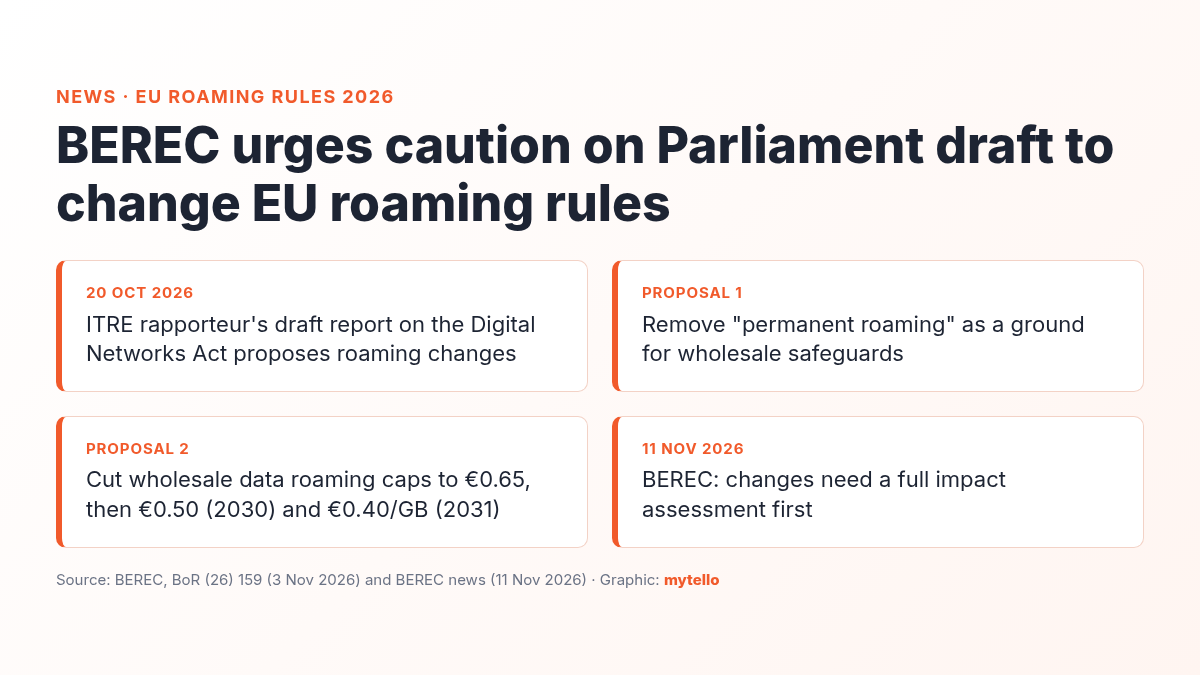
Europe’s telecoms regulators want a full impact assessment before two proposed changes to the EU roaming rules go any further. On 11 November 2026, the Body of European Regulators for Electronic Communications (BEREC) published its views on a draft European Parliament report dated 20 October 2026. The draft would remove “permanent roaming” as a ground for operators’ wholesale safeguards and cut the wholesale price cap for roaming data. BEREC’s message: changes like these should be preceded by a comprehensive impact assessment. Nothing changes for travellers today, but the debate feeds into the review of the roaming rules that is due by 30 June 2027.
EU roaming rules 2026: the key facts at a glance
- Who: BEREC, the body that brings together the EU’s national telecoms regulators.
- What: A short paper titled “BEREC views on the roaming specific topics included in the draft ITRE report of 20 October 2026” (document BoR (26) 159, dated 3 November 2026).
- When: Announced on BEREC’s website on 11 November 2026.
- About what: A draft report by the rapporteur of the European Parliament’s Committee on Industry, Research and Energy (ITRE) on the Commission’s proposal for a Digital Networks Act. According to BEREC, the Commission’s own proposal did not amend the Roaming Regulation; the draft report does.
- What changes for you today: Nothing. The document is a rapporteur’s draft report, not adopted legislation.
What happened
The European Commission has proposed a Digital Networks Act, a new regulation for electronic communications networks. The rapporteur of the European Parliament’s ITRE committee published a draft report on that proposal on 20 October 2026. BEREC notes that the draft goes beyond the Commission’s proposal: it reaches into the separate Roaming Regulation, Regulation (EU) 2022/612, which is the law behind “Roam Like at Home”.
BEREC dated its response 3 November 2026 and announced it on 11 November 2026 under the headline “BEREC views on roaming topics of draft ITRE report”. In its own words, BEREC “considers that such changes require careful assessment of their potential impact on competition, consumers and network investment”. The full four-page paper is available from the BEREC document register.
What the draft report proposes
According to BEREC’s summary, the rapporteur’s draft would change the Roaming Regulation in two ways. The reasons are set out in a new recital (283a) of the draft.
1. No more “permanent roaming” safeguard between operators
Article 3(6) of the Roaming Regulation lets operators include conditions in their wholesale roaming agreements, request information and terminate agreements to protect themselves against permanent roaming and abusive or anomalous use. The draft would delete “permanent roaming” as one of the grounds for these steps.
Permanent roaming means buying a mobile plan in one country and using it mainly, and for good, in another. Roam Like at Home was built for periodic travel. The European Commission’s roaming page says that if you stay and use roaming in another EU country for longer than in your home country over a period of four months, your operator may contact you and may apply a surcharge.
2. Lower wholesale caps for roaming data
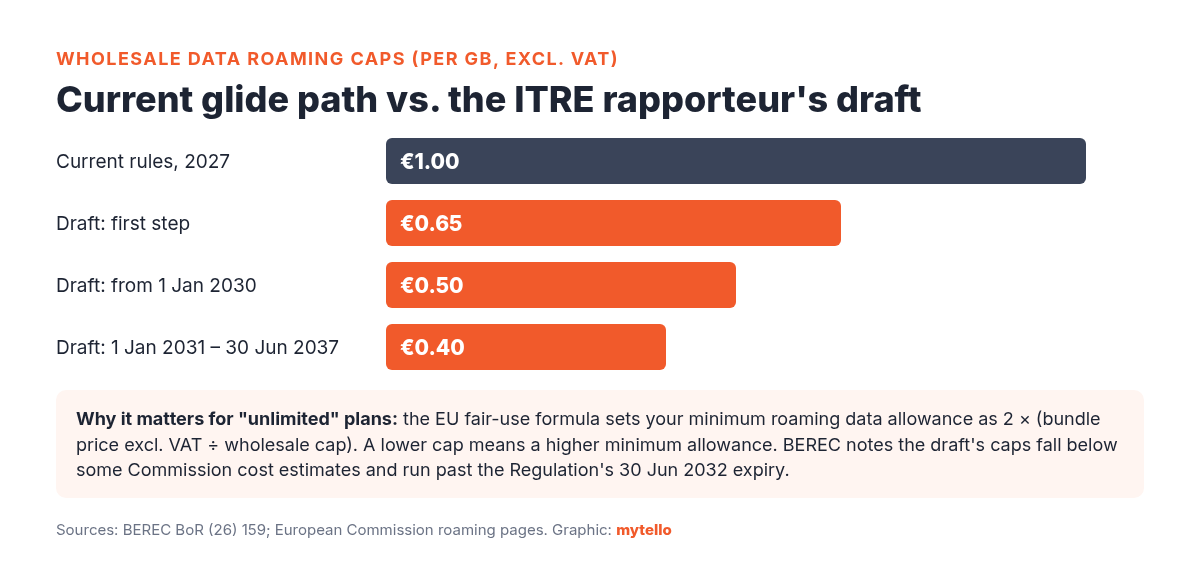
Wholesale caps are the maximum prices operators may charge each other when a customer from one network uses data on another network abroad. The draft would lower the maximum average wholesale charge for data roaming to €0.65 per GB, then to €0.50 per GB from 1 January 2030 and €0.40 per GB from 1 January 2031 until 30 June 2037. Under the current rules, the Commission says the cap was €2 per GB from July 2022 and falls step by step to €1 per GB in 2027.
What BEREC is warning about
BEREC does not reject the goals behind the draft. It says it “strongly supports the objective of developing the internal market” and “has recognized some room for further reductions” of the wholesale caps. Its concern is how and how fast. Here are the main points of the paper.
The current framework still works
BEREC refers back to its 2025 Opinion on the Roaming Regulation (dated 28 March 2025). There it concluded that the existing rules for periodic travel, including the retail fair use policy and the wholesale safeguards in Article 3(6), remain relevant. They let operators protect their domestic price models while travellers still enjoy Roam Like at Home “without unnecessary restrictions”.
Risk to domestic prices and data allowances
Retail prices, network costs and usage patterns differ between EU countries. BEREC warns that weaker safeguards could encourage cross-border arbitrage: people buying a cheaper plan in one country to use it permanently on a more expensive network elsewhere. That could distort competition and push operators to adjust their domestic tariffs or data allowances. BEREC calls this a possible “waterbed effect”, in which roaming costs are passed on to customers at home, including people who rarely roam.
It is important to read this warning correctly. BEREC also writes that it “found no indications of such effects under the existing RLAH framework” in its 2025 Opinion. The warning is about what could happen if the safeguards change, not about something that is happening now.
Risk to investment and network quality
Building networks costs more in some countries than in others, for example because of geography and population density. If many customers could buy cheap plans in one country and use them on networks that were more expensive to build, BEREC says that could hurt operators’ incentives and capacity to invest, and “could lead to lower quality of service on some networks”.
Caps below cost estimates, and a date that doesn’t match
BEREC points out that, for certain Member States and years, the proposed wholesale data caps fall below some cost estimates from the European Commission’s mobile cost model, updated in 2025. It also flags an inconsistency: the draft sets caps until 30 June 2037, while the Roaming Regulation itself expires on 30 June 2032.
BEREC’s conclusion is that any proposal to remove or substantially change the safeguards, or to significantly revise the glide path for wholesale caps, “should therefore be preceded by a comprehensive impact assessment”.
What it means for travellers and callers
For now, the rules you travel with stay the same. Here is what the European Commission’s roaming Q&A and roaming page say about the current regime:
- It is automatic. Roam Like at Home is the default on plans that include roaming. You don’t need to activate anything.
- Where it applies: all 27 EU countries plus Iceland, Liechtenstein and Norway. Since 1 January 2026, it also covers Ukraine and Moldova.
- Where it doesn’t: countries outside the EU/EEA, including the United Kingdom. Some operators extend their offers there voluntarily, so check before you travel.
- How long: the rules have been prolonged until 2032.
- Fair use: on unlimited or very cheap data plans, operators may set a roaming data limit. They must tell you in advance and warn you when you get close.
- Watch out for special numbers: calls to value-added numbers such as airline, insurance or customer service hotlines can cost extra while roaming. Your operator must tell you which number types may be charged more.
Why lower wholesale caps could mean more data on “unlimited” plans
The wholesale cap sounds like a deal between operators, but it feeds straight into your fair use allowance. The Commission explains that your minimum roaming data volume must be at least twice the price of your mobile bundle (excluding VAT) divided by the regulated wholesale cap per GB. BEREC makes the same point in a footnote: “Lower caps raise the minimum data volume to be provided at domestic price under open data bundles.”
Here is a simple illustration of that formula for a plan costing €20 per month excluding VAT. The numbers are our own calculation, not an official forecast:
| Wholesale cap per GB | Formula: 2 × (€20 ÷ cap) | Minimum roaming data |
|---|---|---|
| €1.00 (current rules, 2027) | 2 × (20 ÷ 1.00) | 40 GB |
| €0.65 (draft, first step) | 2 × (20 ÷ 0.65) | about 61 GB |
| €0.50 (draft, from 2030) | 2 × (20 ÷ 0.50) | 80 GB |
| €0.40 (draft, from 2031) | 2 × (20 ÷ 0.40) | 100 GB |
That is the trade-off in this debate. Lower caps would give heavy data users more room abroad. BEREC’s worry is that, if caps fall below cost in some countries, operators might make up the difference elsewhere.
Context: the other EU price rule for calls between countries
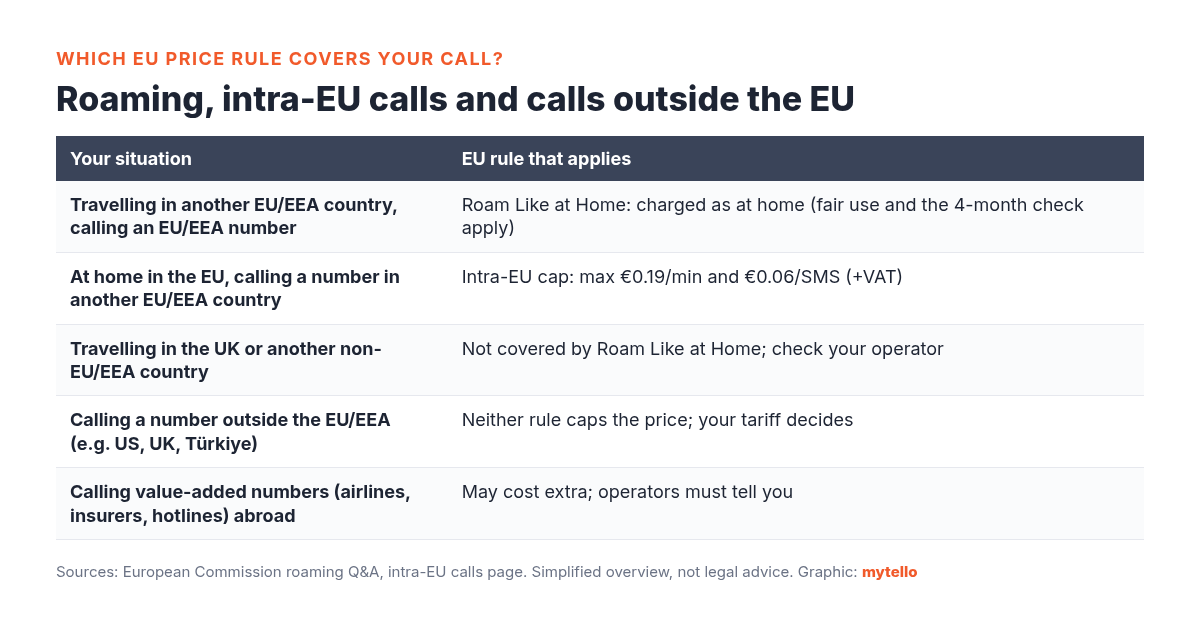
Roaming is about using your phone while you travel. A separate EU rule covers calls you make from home to another EU country. Since 15 May 2019, a call from one EU country to another costs at most €0.19 per minute and an SMS at most €0.06, both plus VAT. The cap covers calls and texts to other Member States plus Iceland, Liechtenstein and Norway, from both landlines and mobiles, as the Commission’s page on intra-EU calls explains. Before the cap, the Commission says, an intra-EU call tended to cost about three times as much as a domestic call on average.
This rule is also moving:
- 17 December 2025: the Commission adopted an implementing act on intra-EU communications. Providers can now choose to charge the same price for intra-EU calls as for domestic ones. In return they may apply a fair use policy and are not bound by the price caps. The Commission calls this “a first step” towards a possible phase-out of price differences.
- From 1 January 2029: retail prices for regulated intra-EU calls and SMS should not differ from domestic prices, “subject to the applicable technical conditions”, as BEREC describes the plan in its call for inputs.
- Now: BEREC collected input until 6 November 2026 for an Opinion to the Commission on how this framework is working.
One thing neither rule does: cap the price of calling a number outside the EU/EEA. A call from Germany to the United States, the United Kingdom or Türkiye is priced by your own tariff.
Looking ahead: the timeline
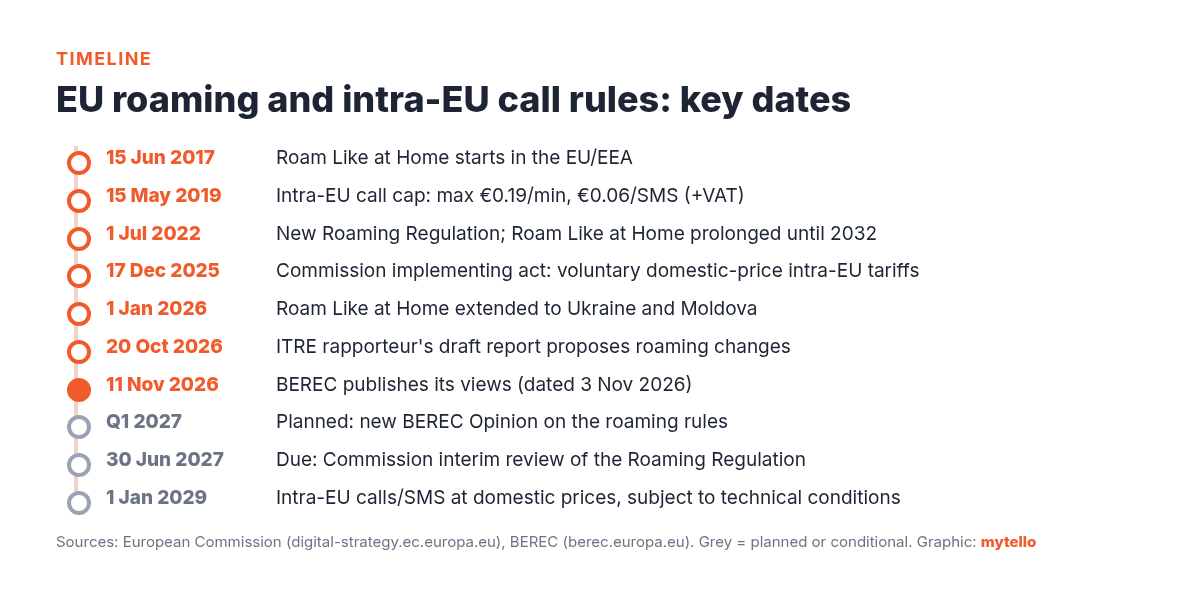
- Parliament: the 20 October 2026 text is a rapporteur’s draft report, so it is not yet an adopted position.
- Q1 2027: BEREC says it will publish an Opinion “to support an evidence-based evaluation of the existing rules and any potential adjustments”.
- By 30 June 2027: the Commission must submit an interim report on how the Roaming Regulation works. Depending on its findings, it may come with a legislative proposal.
- Western Balkans: the Council authorised talks in June 2026, and on 6 November 2026 the Commission announced it had opened negotiations to bring Albania, Bosnia and Herzegovina, Kosovo, Montenegro, North Macedonia and Serbia into Roam Like at Home. There is no set deadline.
- 1 January 2029: the planned move to domestic prices for intra-EU calls and SMS, under conditions.
- 30 June 2032: the current Roaming Regulation expires.
Video: how the EU explained Roam Like at Home
For background, here is a 41-second clip from DigitalEU, the European Commission’s digital policy channel. It was published in February 2021, when the Commission proposed extending Roam Like at Home beyond June 2022, the step that led to today’s rules running until 2032.
How to keep international calls affordable in the meantime
Whatever happens in Brussels, the gaps in today’s rules are clear. Roam Like at Home doesn’t cover the UK or other non-EU countries, and no EU cap applies when you call a number outside the EU/EEA. If you regularly call family, friends or businesses in those countries, a few habits help:
- Check your operator’s roaming conditions before trips to non-EU countries, especially the UK. Our guide to avoiding roaming charges when calling abroad walks through the usual traps.
- Don’t rely on Wi-Fi calling alone. It doesn’t always work abroad, as we explain in why Wi-Fi calling may not work abroad.
- Compare per-minute prices for your destination before you call. Our overview of roaming alternatives for calling compares the main options.
- Calling Europe from the US? See how to call Europe from the USA.
mytello is one simple option. It works from any landline or mobile phone through dial-in numbers, with no contract and no basic fee. The person you call doesn’t need internet or the app. Your credit never expires, and you can try it with a free test call. See the rates for your destination, for example calls to the UK or calls to Türkiye.
Sources
All sources were checked on 23 November 2026.
- BEREC: BEREC views on roaming topics of draft ITRE report (news, 11 November 2026)
- BEREC: BoR (26) 159, BEREC views on the roaming specific topics included in the draft ITRE report of 20 October 2026 (3 November 2026)
- BEREC: BEREC Opinion on Regulation (EU) 2022/612 on roaming (28 March 2025)
- BEREC: Call for inputs on the review of the regulatory framework for regulated intra-EU communications
- European Commission: Roaming: connected anywhere in the EU at no extra charge
- European Commission: Roaming: Questions & Answers
- European Commission: Intra-EU calls: limited charges for calling other EU countries
- European Commission: Implementing Act on intra-EU communications (17 December 2025)
- European Commission: Commission opens negotiations to extend ‘Roam Like at Home’ to the Western Balkans (6 November 2026)
This article summarises official publications for general information. It is not legal advice. Check your operator’s terms for the conditions that apply to your plan.