You have a phone number from another country and one simple question: what exactly do I dial? This international dialing code generator answers it. Pick the country you are calling from and the country you are calling to, type the number if you have it, and you get the full dialing sequence, ready to copy.
It covers 245 countries and territories and runs entirely in your browser. Below the tool you’ll find what each part of the result means, an exit-code table for popular destinations and answers to common questions.
International dialing code generator
Choose where you are calling from and where you are calling to. Optionally type the number the way it is written in that country.
Data: Google libphonenumber metadata (release 9.0.44, Apache License 2.0), checked against ITU dialling-procedure lists. Country names: Unicode CLDR. The tool runs entirely in your browser and sends nothing anywhere.
What the result means
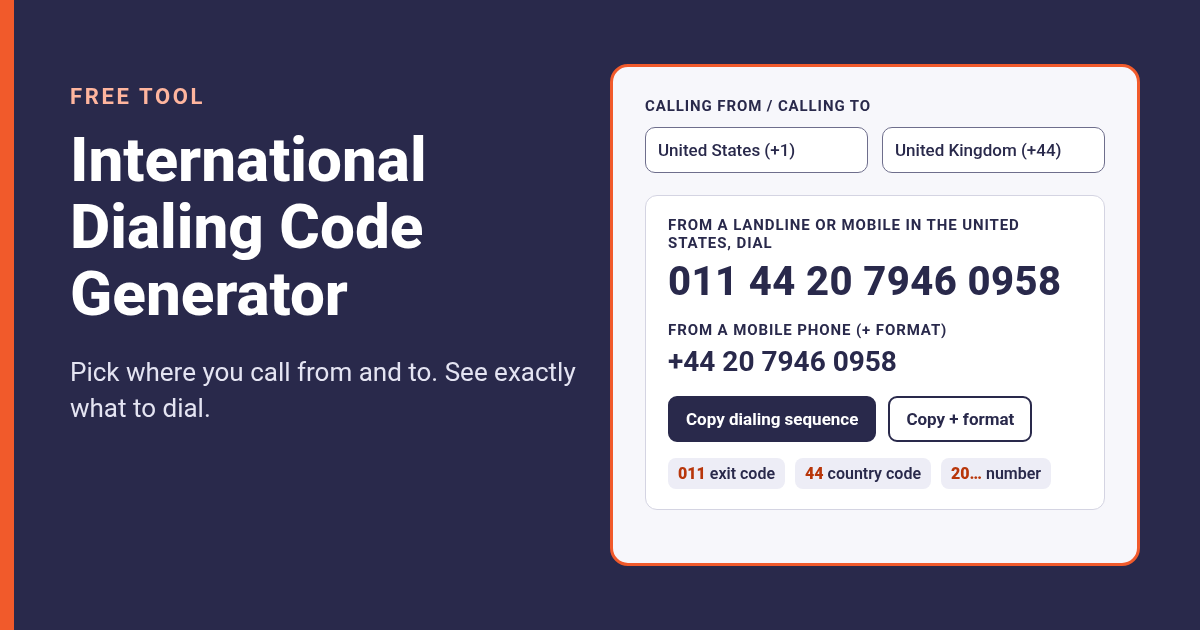
Every international number you dial from a landline is built from the same three or four pieces. Take the default example in the tool, a call from the United States to a London number written locally as 020 7946 0958:
| Part | Example | What it does |
|---|---|---|
| Exit code (international prefix) | 011 | Tells your phone company that the call leaves the country. It depends on where you are calling from. |
| Country code | 44 | Identifies the country you are calling. It depends on where you are calling to. |
| Trunk prefix (dropped) | The leading 0 is only dialled inside the UK, so you leave it out from abroad. | |
| Area code + local number | 20 7946 0958 | The rest of the number, exactly as written after the trunk prefix. |
The International Telecommunication Union (ITU) defines these pieces in its list of national dialling procedures: the international prefix is what you dial "before a country code when dialling a call to a country other than the one from which the call is being placed", and the national (trunk) prefix is dialled before an area code for calls inside a country, which is why "in the international service the trunk prefix of the country of destination must not be dialled" (ITU Operational Bulletin 994, dialling procedures).
The + sign replaces the exit code
On a mobile phone you usually don't need to know the exit code at all. Verizon explains that "Plus Dialing allows you to use the plus symbol instead of dialing an exit code"; on an iPhone you touch and hold 0 until + appears, then enter the country code and the number (Verizon: Use Plus (+) Dialing). That's why the tool always shows a second line, such as +44 20 7946 0958. Save numbers in your contacts in this format and you don't need to look up the local exit code when you travel.
Calling within North America: no exit code
The United States, Canada and many Caribbean countries share country code +1. NANPA describes the North American Numbering Plan as "an integrated telephone numbering plan serving 20 North American countries" (NANPA: About the NANP). Between them you don't dial 011. The FCC puts it simply: calling Canada and most Caribbean nations works like a domestic long-distance call, so you "dial 1, the area code, and the number" (FCC international calling tip sheet). Bell Canada gives the same pattern from Canada: 1 + area code + local number within North America, and 011 + country code + city or area code + local number for overseas calls (Bell: international and North American calling codes). Choose United States to Canada in the tool and it shows exactly that.
International dialing codes: exit codes by country
The exit code depends only on the country you are in. The country code and the trunk prefix belong to the country you are calling. This table lists a selection of popular destinations; the tool above covers all of them.
| Country | Exit code (calling out) | Country code (calling in) | Trunk prefix to drop from abroad |
|---|---|---|---|
| United States | 011 | +1 | 1 |
| Canada | 011 | +1 | 1 |
| United Kingdom | 00 | +44 | 0 |
| Ireland | 00 | +353 | 0 |
| Germany | 00 | +49 | 0 |
| France | 00 | +33 | 0 |
| Italy | 00 | +39 | none (dial the number in full) |
| Spain | 00 | +34 | none (dial the number in full) |
| Netherlands | 00 | +31 | 0 |
| Belgium | 00 | +32 | 0 |
| Austria | 00 | +43 | 0 |
| Switzerland | 00 | +41 | 0 |
| Poland | 00 | +48 | none (dial the number in full) |
| Portugal | 00 | +351 | none (dial the number in full) |
| Sweden | 00 | +46 | 0 |
| Greece | 00 | +30 | none (dial the number in full) |
| Hungary | 00 | +36 | 06 |
| Romania | 00 | +40 | 0 |
| Australia | 0011 | +61 | 0 |
| New Zealand | 00 | +64 | 0 |
| Japan | 010 | +81 | 0 |
| China | 00 | +86 | 0 |
| South Korea | Depends on your carrier | +82 | 0 |
| India | 00 | +91 | 0 |
| Pakistan | 00 | +92 | 0 |
| Philippines | 00 | +63 | 0 |
| Mexico | 00 | +52 | none (dial the number in full) |
| Brazil | Depends on your carrier | +55 | 0 |
| Colombia | Depends on your carrier | +57 | 0 |
| Russia | 8, tone, 10 | +7 | 8 |
| Türkiye | 00 | +90 | 0 |
| United Arab Emirates | 00 | +971 | 0 |
| Nigeria | 009 | +234 | 0 |
| South Africa | 00 | +27 | 0 |
The tricky cases
- United States and Canada: 011 for overseas calls, but no exit code between +1 countries (see above).
- Italy: Italian landline numbers start with 0 and the 0 stays when you call from abroad. A number written 06 xxxx xxxx becomes +39 06 xxxx xxxx. The tool keeps it automatically.
- Hungary: the trunk prefix is 06, not 0, and both digits are dropped from abroad.
- Russia, Kazakhstan and a few neighbours: libphonenumber lists the exit code as 8~10, where the tilde "signals waiting for the tone": dial 8, wait for the dial tone, then 10 (libphonenumber). Ukraine is listed the same way as 0~0: dial 0, wait for the dial tone, then 0. On a mobile, simply use +. The tool's Copy button copies the digits only (810 or 00), without the pause, so wait for the second dial tone yourself.
- Mexico: the FCC says callers dialing a Mexican mobile number should no longer add a 1 after Mexico's country code 52. From a US landline you "dial 011 then the country code for Mexico, which is 52, and then the 10-digit phone number including area code" (FCC).
- Brazil, Colombia, South Korea and a few others: the exit code includes a carrier selection code, so there is no single answer. In Brazil it is 00 plus a two-digit carrier code (for example 0021). libphonenumber itself falls back to the + sign when a country has several international prefixes and no preferred one. The tool shows the options for these countries and recommends the + format on a mobile.
- Countries that share a code: besides +1, the UK shares +44 with Jersey, Guernsey and the Isle of Man, and Russia shares +7 with Kazakhstan. Between them, check with your phone company or use the + format.
How to dial an international number, step by step
- Find the exit code of the country you are in (011 in the US and Canada, 00 in most of Europe, 0011 in Australia, 010 in Japan).
- Add the country code of the country you are calling (44 for the UK, 49 for Germany, 91 for India).
- Take the local number and drop the trunk prefix, usually the first 0 (but not for Italy).
- Dial the digits one after another; the spaces are only there to make the number easier to read (the exceptions are Russia's 8, tone, 10 and Ukraine's 0, tone, 0, where you wait for a second dial tone).
- On a mobile, replace step 1 with + and you are done.
If you call the UK from North America often, our detailed guide on how to call the UK from the USA or Canada walks through landlines, mobiles and costs. For Pakistan, see calling Pakistan from the USA: the exact steps.
Tips for getting the number right
- Save contacts in + format. With +44 20 7946 0958 in your phone you don't need to know the exit code of the country you are in. A number saved as 020 7946 0958 is written for calls inside the UK.
- Watch for (0) in brackets. In numbers written as +44 (0)20 …, the (0) is the trunk prefix, which is only for calls inside the country. Skip it when dialling from abroad. The tool removes it if you paste such a number.
- Don't add a 0 that isn't there. Some countries (Spain or Italy, for example) have no trunk prefix, so there is nothing to drop.
- Mobile numbers can follow different rules. The FCC advises asking your provider about the dialing process and rates, because "In some countries, there is a different procedure for calling a mobile phone number" and calling a mobile can cost more than a landline (FCC).
- Toll-free numbers can be a problem from abroad. Look for the company's number for international callers, or read our guide to calling landlines and toll-free numbers from abroad.
- Check the time first. A correct number doesn't help if it's 3 a.m. there. See how to avoid time zone mistakes when calling abroad.
- Avoid the classic errors. Our list of international calling mistakes to avoid covers the most common ones, from roaming to missing prefixes.
FAQs
What is an international dialing code?
People use the term for two different things: the exit code (international prefix) you dial to leave your country, such as 011 or 00, and the country code of the destination, such as 44 or 49. A complete international number needs both, or a + instead of the exit code on a mobile.
Is 00 the same everywhere?
No. ITU recommends 00 to countries that are introducing or revising their international prefix, and most countries use it (188 of the 245 countries and territories in our data), but not all: the US and Canada use 011, Australia 0011 and Japan 010 (ITU). In a few countries the code depends on the carrier.
What do I dial to call the US from abroad?
Your local exit code, then 1, then the 10-digit number. From the UK or Germany that's 00 1 212 555 0123; from Australia it's 0011 1 212 555 0123; from a mobile anywhere it's +1 212 555 0123. (NANPA keeps 555-0100 to 555-0199 reserved as fictitious, non-working numbers for entertainment and advertising, which is why we use them as examples.)
Why does my call fail even though the code looks right?
The usual causes are a trunk prefix that wasn't dropped (dialling 011 44 020 … instead of 011 44 20 …), a missing digit, or a number that only works for callers inside the country. Try the + format from a mobile and compare the digits with the tool's result.
How accurate is this tool, and where does the data come from?
The exit codes, country codes and trunk prefixes come from Google's open-source libphonenumber metadata (release 9.0.44 of 18 November 2026, Apache License 2.0), Google's open-source library "for parsing, formatting, and validating international phone numbers". We cross-checked the main countries against ITU's dialling-procedures list and its list of assigned country codes; the country codes themselves are assigned under ITU-T Recommendation E.164. Some ITU lists date from 2011 and 2016, and some codes have changed since (Uzbekistan's exit code is 810 in the 2011 ITU list; the libphonenumber data notes it "is changed to '00' from '8~10'"), so where they differ the tool follows libphonenumber, whose data is newer than the 2011 ITU list. If a call doesn't go through, your phone company has the final word.
Are the example numbers real?
No. The tool only shows example numbers from ranges set aside for fiction: London 020 7946 0xxx (Ofcom's drama range), US and Canadian 555-0100 to 555-0199 (NANPA) and Australian (02) 5550 xxxx (ACMA). For other countries it shows a placeholder until you type a number.
Does the tool store or send my number?
No. The tool runs entirely in your browser: it sets no cookies, saves nothing and makes no network requests, so the number you type stays on your device.
Calling abroad regularly? Make it cheaper
Knowing what to dial is half the job; the other half is what the call costs. mytello lets you make international calls from any landline or cell phone via dial-in numbers, with no contract and no basic fee. The person you call doesn't need internet or mytello. Credit never expires, there's a money-back guarantee, and after free registration you can make a short free test call. See the mytello rates by country. The country pages show rates for calls from the USA, for example calls to the UK, Mexico or India.
Planning calls to several European countries? Our guide to the cheapest ways to call Europe from the USA compares the options.